Science Education in the News: "Schools Cut Back Subjects to Push Reading and Math" Reports New York Times
A March 26 New York Times article reports that a survey to be released later this week on narrowing the curriculum finds that since No Child Left Behind was passed in 2001, 71% of the nation’s 15,000 school districts have reduced the hours of instructional time in history, science, music, and other subjects to open up more time for reading and math. “The intense focus on the two basic skills is a sea change in American instructional practice, with many schools that once offered rich curriculums now systematically trimming courses like social studies, science and art,” writes reporter Sam Dillon. The article reports the many ways district administrators are attempting to shore up their math and reading instruction, often barring students from taking anything but these subjects. To read the entire article, visit http://www.nytimes.com/2006/03/26/education/26child.html?_r=1&oref=slogin.
A New York Times editorial by Thomas Friedman titled “Worried About India's and China's Booms? So Are They” finds that one of the most frequent debates in most countries focuses on education and the common premise that they are falling behind. From the U.S. and Great Britain to India and China, every country is struggling with its own set of challenges. Friedman points to a “global convergence in education” that will spur growth and innovation. The challenge, he states, is for countries to find the right balance between creativity and rigor. Subscribers of the New York Times Select service can read the entire article at http://select.nytimes.com/2006/03/24/opinion/24friedman.html?th&emc=th. For others, read a synopsis at http://science.nsta.org/nstaexpress/nstaexpress_2006_03_27_synopsis.htm.Science Education in the News: "Schools Cut Back Subjects to Push Reading and Math" Reports New York Times
A March 26 New York Times article reports that a survey to be released later this week on narrowing the curriculum finds that since No Child Left Behind was passed in 2001, 71% of the nation’s 15,000 school districts have reduced the hours of instructional time in history, science, music, and other subjects to open up more time for reading and math. “The intense focus on the two basic skills is a sea change in American instructional practice, with many schools that once offered rich curriculums now systematically trimming courses like social studies, science and art,” writes reporter Sam Dillon. The article reports the many ways district administrators are attempting to shore up their math and reading instruction, often barring students from taking anything but these subjects. To read the entire article, visit http://www.nytimes.com/2006/03/26/education/26child.html?_r=1&oref=slogin.
A New York Times editorial by Thomas Friedman titled “Worried About India's and China's Booms? So Are They” finds that one of the most frequent debates in most countries focuses on education and the common premise that they are falling behind. From the U.S. and Great Britain to India and China, every country is struggling with its own set of challenges. Friedman points to a “global convergence in education” that will spur growth and innovation. The challenge, he states, is for countries to find the right balance between creativity and rigor. Subscribers of the New York Times Select service can read the entire article at http://select.nytimes.com/2006/03/24/opinion/24friedman.html?th&emc=th. For others, read a synopsis at http://science.nsta.org/nstaexpress/nstaexpress_2006_03_27_synopsis.htm.
Tuesday, March 28, 2006


Saturday, March 18, 2006
Macbreak: Leo Laporte demonstrates WinXP running on a Mac Mini
Windows XP on an Intel Core Solo Mac Mini. Wow! This could be the answer to my school's dream machine. My students love using the Apple multimedia program like iMovie, iPhoto, and iDVD. There are also many programs that still just run on Windows that we have. My students prefer to use Publisher over Apple's Page, and Access Database is a program that our students must master in order to pass the NC 8th Grade Computer Skills Test. I know that we could use MS Works still for our high school kids to learn how to use databases, but no one in the real world uses it. Some school using Apple have purchased third party database programs to teach their students the skills of query and filtering a database. My students that can not pass the 8th Grade Computer Skills Tests have computer skills. They can find every game site not blocked by our server. They can locate every photo of a PitBull and print it out with enough copies for all the homies. They can surf to very NBA star and their favorite male and female rap star on the Internet. My point is that DPI's computer literacy skills and my "darlings" are on opposite ends of the poles. It is a cultural issue. It is the conflict between Digital natives versus digital immigrants.
"OUR STUDENTS HAVE CHANGED RADICALLY," this is the observation of Marc Prensky in his article "Digital Natives, Digital Immigrants." (Prensky, October 2001.) Today's students and young workers are part of a cohort he calls "Digital Natives." Raised on MTV, video games, e-mail, the Web and instant messaging, Digital Natives have developed cognitive thinking patterns that differ from previous generations. As a result, the challenge facing educational designers is to recognize these cognitive differences and to develop learning offerings that are appropriate to their cognitive learning patterns.
The same is true for 2006 classroom, but it getting worse. Add to this the fact that of my students, a vast majority of them still do not have access to the web at home. The students I teach tend to be more Digital Have-Nots. Oh, some have cell phones and CD players to listen to on the school bus. However, cable connections, dial-up and DSL are fell and far between. Sure I have more students in my 2006 classroom with Internet access, but the fact is, their still remains a glaring digital divide. Computers are still complicated and are seen by many families as a low priority to medicine and health care expenses, gas prices-- going out the roof again!, food costs-- heading up with fuel costs, rent, cable bills, cell phone bills, and on and on.
I really like the idea of a MacMini, able to run Windows XP and OS X. That is just too simple and makes me feel warm and fuzzy inside.
read more | digg story
"OUR STUDENTS HAVE CHANGED RADICALLY," this is the observation of Marc Prensky in his article "Digital Natives, Digital Immigrants." (Prensky, October 2001.) Today's students and young workers are part of a cohort he calls "Digital Natives." Raised on MTV, video games, e-mail, the Web and instant messaging, Digital Natives have developed cognitive thinking patterns that differ from previous generations. As a result, the challenge facing educational designers is to recognize these cognitive differences and to develop learning offerings that are appropriate to their cognitive learning patterns.
The same is true for 2006 classroom, but it getting worse. Add to this the fact that of my students, a vast majority of them still do not have access to the web at home. The students I teach tend to be more Digital Have-Nots. Oh, some have cell phones and CD players to listen to on the school bus. However, cable connections, dial-up and DSL are fell and far between. Sure I have more students in my 2006 classroom with Internet access, but the fact is, their still remains a glaring digital divide. Computers are still complicated and are seen by many families as a low priority to medicine and health care expenses, gas prices-- going out the roof again!, food costs-- heading up with fuel costs, rent, cable bills, cell phone bills, and on and on.
I really like the idea of a MacMini, able to run Windows XP and OS X. That is just too simple and makes me feel warm and fuzzy inside.
read more | digg story
Monday, March 13, 2006
Photos of the "Alien Cells" Found in Red Rain
The academic paper about the red rain phenomenon has several pictures of the cells. I have cut-n-pasted the photos from the PDF and put them up for easy viewing. Pretty amazing pictures!
read more | digg story
read more | digg story
The Most Intense Solar Storm In Fifty Years Is Coming
It's official: Solar minimum has arrived. Sunspots have all but vanished. Solar flares are nonexistent. The sun is utterly quiet.
"The next sunspot cycle will be 30% to 50% stronger than the previous one," she says. If correct, the years ahead could produce a burst of solar activity second only to the historic Solar Max of 1958.
read more | digg story
"The next sunspot cycle will be 30% to 50% stronger than the previous one," she says. If correct, the years ahead could produce a burst of solar activity second only to the historic Solar Max of 1958.
read more | digg story
137 Online Tools for Webmaster
An must keep one-for-all list for online free tools that help webmaster, programming, and web design to program, design, develope, optimize web sites.
read more | digg story
read more | digg story
Saturday, March 11, 2006
Cingular, T-Mobile stop Razr cell phone sales
Companies say a glitch in Motorola's wildly popular phone causes dropped calls or shut down; Motorola stock tumbles over 2 percent. Saw this and had to share my observations of this piece of junk. My sister in law lives in Tampa, FL and has one of these "fishing sinkers." She one and while our family visited her I asked her what she thought about the Razr. Well lets just say, she was not a happy customer. She complained about the dropped calls and shut downs. One the way from the airport, in heavy traffic, her husband called her to see if our flight had arrived. I witnessed the phone dropping the call at least three or four times on a straight highway with no overpasses. This was in Tampa and the service coverage there is usually flawless. I thought it was her phone and how she had mistreated it. However, her son, my nephew, who has owned a cell phone from birth, was having the same issues with his Razr.
Bottom line-- Any one can build a piece of junk, but to sell it to folks that trust the brand, well Moto needs to show some customer appreciation and replace these Lemons.
Technology is fine when it works, but can cost a bunch and bug the heck out of you too.
read more | digg story
Bottom line-- Any one can build a piece of junk, but to sell it to folks that trust the brand, well Moto needs to show some customer appreciation and replace these Lemons.
Technology is fine when it works, but can cost a bunch and bug the heck out of you too.
read more | digg story
Wednesday, March 08, 2006
Reflecting on Using Technology In My Classroom
We have just started using the Apple's updated Garageband 6 in our classroom podcast. My students really like it much better than the older version. The like the bundled sound loops. After recording, we just click the images they want straight from the photo album. Currently, we are using the Apple shared photo feature so the students can access all photos in the classroom. They use the images to create enhanced podcasted. However, the size of the podcast file is huge when they include all the images and sound effects they like. I have decided to post a non-enhanced version to our iWeb site to avoid exceeding our small 1GB on .MAC. Hopefully, we will be able to up the server space next school year. I have promised the students that we will burn them CDs of the enhanced podcasts to take home for their families to enjoy. This is a tip I learned from Bob Sprankle at Room 208 We also love the new iWeb. Check out our classroom's iWeb: http://web.mac.com/blakej78 We have posted a few podcasts on this, and hope to have a new one up on using BubbleShare and Bloglines, and our science study of motion. My students created a claymation animation of mitosis. I am working on posting this soon to our site.
Today, my students (ages 16-20 Seniors in High School) create a BubbleShare.com site, and post images from the classroom. Their sites are set as PRIVATE, not PUBLIC. To share the images with every student, we created blogline.com accounts and shared through email, the addresses to the student's BubbleShare account. That means that only folks that they send the link to has access to the photos. Our lesson tomorrow is responsible ethical use of photos on the web. We are going to talk about copyright, and digital rights management. I made it very clear that they are not to use their last names in anyway. I was very surprised that all 10 of them had MySpace accounts. They were very lacks about following this rule until I gave them zeros for the assignment until they removed all identifying info from their photosharing site. So, you might want to share that tip with other teachers. We do not use MySpace.
Two of my students are already signed up to join the Military after graduation from high school. I sold them on the idea of learning how to use this tool so they could be able to send me photos of them when they get to Baghdad! Sad, but true.
Next, I hope to have them learn to pod to a blog. We are not going to use a public blog, I want to use David Warlick's Blogmeister blog site.
Today, my students (ages 16-20 Seniors in High School) create a BubbleShare.com site, and post images from the classroom. Their sites are set as PRIVATE, not PUBLIC. To share the images with every student, we created blogline.com accounts and shared through email, the addresses to the student's BubbleShare account. That means that only folks that they send the link to has access to the photos. Our lesson tomorrow is responsible ethical use of photos on the web. We are going to talk about copyright, and digital rights management. I made it very clear that they are not to use their last names in anyway. I was very surprised that all 10 of them had MySpace accounts. They were very lacks about following this rule until I gave them zeros for the assignment until they removed all identifying info from their photosharing site. So, you might want to share that tip with other teachers. We do not use MySpace.
Two of my students are already signed up to join the Military after graduation from high school. I sold them on the idea of learning how to use this tool so they could be able to send me photos of them when they get to Baghdad! Sad, but true.
Next, I hope to have them learn to pod to a blog. We are not going to use a public blog, I want to use David Warlick's Blogmeister blog site.
Sunday, March 05, 2006
Thursday, March 02, 2006
IMHO-- Our District Web Pages Are 'Old School'
District web pages were the topic of a podcast by Jeff Moore over on One Big Head. He is a very forward thinker and one podcast that I never delete, until I have replayed in my iPod a couple of times while working out in the gym after school. I am still trying to get my head around what Jeff talks about in this episode. I may have to listen to the podcast again tomorrow after a good night's sleep. I liked the way Jeff weaved the idea of how schools have an industrial culture. Well that is not how he states it. He is much more politically correct. Schools have a culture. State and Federal mandates along with local goals direct our school web page content. What content is on our pages reflects the industrial nature/departmentalized approach to managing our schools. Should we change our districts website? Not if it is just for looks. Not just to change for the heck of it. We should change to reflect the evolution of the Internet. It is time for our district to begin moving from the static web page to dynamic information content management.
In this episode, I offer thoughts on MySpace that are going to make me unpopular. Listen carefully, though--it's not MySpace that's the problem. It's our institution. Also, some realizations about my school district's website: how can its evolution bring change in the organization at large? We use Mambo, which forced us to do some things differently. Click here to listen.
Saturday, February 11, 2006
Spirit Mars Rover Reaches 'Home Plate': Formation Has Researchers Puzzled
NASA's Spirit Mars rover has arrived at a site dubbed "Home Plate" within Gusev crater. But what the robot found has left scientists puzzled.
What do you think it could be?
read more | digg story
What do you think it could be?
read more | digg story
Tuesday, January 31, 2006
Thanks for the Shout-Out
A very NICE mini-conference
Filed under: Musings — Steve @ Jan 30, 06 | 7:37 am
I know, I know, the title of the post is corny, but how can you avoid it when the group hosting the mini-conference is named "NICE", Northern Illinois Computing Educators? The conference itself was a resounding success. There were only three time slots, perfect for a half day mini-conference. I did a quick 45 minute overview of Educational podcasting. You can read Dick’s write up of it here and check out the resource page here. I really should post the entire presentation there. I wish I had recorded it. I was planning to record it on my camera, but seems as though I forgot to charge it up the night before and the battery was dead. Anyway, it went smooth, and based on the comments people shared with me afterwards, quite a few people left the session thinking to themselves, "You know, I really think I could do that." I’m pretty satsified with that. I also attended a session about using Moodle for virtual staff development, hosted by Charlene Chausis. Charlene is the staff development trainer at Stevenson High School and showed off a Moodle course that she created discussing teaching technology to Digital Natives. To be honest, I want to attend that course! I must admit that I was surprised to see that John Blake and Wesley Fryer were already attending and participating in the course! I wonder if Charlene’s teachers know that she’s really got some heavy hitters playing in the sandbox with them? Anyway, the class itself was very informational to me. It had been a long time since I played around with Moodle, and I definitely learned about some features that I either forgotten or never knew about to begin with. It looks perfect for this project I’m going to be getting started on soon (very hush hush, but I’ll share when I can). Charlene also did a great job of sharing projects that other schools have been working on. Great stuff and well worth the time. The quality of Open Source products never cease to amaze me.
Proud to me mentioned in the same sentence with Wes Fryer. Thanks for the kind words Steve. Moodle has been a real life saver for me. It forces me to plan my lessons much more completely than a conventional lesson. I am struggling with finding new ways to teach using Moodle. Coming up with creative engaging activities that force my students out of their comfort zone is a challenge. They feel very safe with filling in the blanks in a worksheet. Moodle lets teachers prepare these activities. I finally tried a lesson module this week. It worked great. However, it took hours to prepare. I have downloaded eXe, which is a content editor I am trying to learn use with Moodle. The trick in using Moodle is to have the students create their own learning activities. HotPotatoes is my favorite tool.
I need to look at Charlene's course again to steal some ideas...check you later...
Wednesday, January 25, 2006
Social Bookmarking
I know when I post articles about social bookmarking tools, someone is going to read it and post a comment. Bookmarking companies really understand how to use search engines so, I am going to be very truthful and precise. I have be very happy using Del.icio.us for almost an entire school year. My students had issues with trying to use bookmarking software in class. I never have been able to pin-point their reluctance in using bookmarking tools. I read a post on Tim Lauer's blog:
The great thing about Scuttle is that you can download the source and run the application on your own server. Today my friend, Dick McPartland, came by and installed the necessary software and we now have Scuttle running locally at, Lewis Elementary. This means that we can provide our students with a social bookmarking tool, running locally in our building. Several teachers have asked for a tool similar to del.icio.us. I wanted to set up so that students did not have to create a login on a remote system.The idea of hosting our own bookmarking software makes good sense so my students will not have to create a login to use the bookmarks. When I created a Del.icio.us bookmark account for my class to use, they never could remember the password. I tried changing the password to a very simple password like the initials of our school. That did not work. Wrote it on the board at the front of the class, but they could not remember the URL. Tried installing the javascript bookmark button on their browser, I just need a better way. I do not mean this ugly, but it seems that my students are not 'digital natives', unless they are searching for wrestling, pit bulldog images, or online game sites. If it is something they want to find, they are wizzards. If it is instructional, they basically act like they are oxygen deprived. Could it be a lack of motivation? Basically, it is a very frustrating to me. How many times do I have to reteach how to use social bookmarking?
Sunday, January 22, 2006
Social Software
 What is Frappr?
 Frappr is an online tool that lets you map out the city where you live, work, vacation, or anything else! You can then share your unique URL with friends and find out where the rest of them live and work in relation to everyone else. It's great for keeping in touch with friends, families, and groups! You can also share photos, private message them, or leave comments on their MyFrappr homepage.Could be heading down a road I do not want to travel, but...here goes! This social software seems to have features that could be interesting to try in my classroom. After reading about how a teacher in a nearby school district got into trouble. Seems a someone, posted on his MySpaces blog, what was described as a lewd photo (probably 'photoshopped'). A parent printed out the photo and took it to the adminstration of the school. Lesson learned, teachers may not necessarily want to have a page that can is not password protected. How does Frappr protect teachers from the possiblity of vandalism? I am not sure. I have read the statement below on their site:
How public are these Frapprs?Our Frappr class group is not included in Frappr's Public Directory so unless the students know the url or Frappr name.
If you don't enable the "Add to Frappr's Public Directory" checkbox, the Frappr doesn't show up in "Browse Other Groups" and it isn't searchable. No one can view the map unless they know the url or Frappr name, or they happen to browse across one in someone's MyFrappr homepage.
So, first step: Teach students the ethical use of these shared photo social software. A question is where do teachers find resources to use with this "lesson"? This is a problem with being on the 'bleeding-edge' of technology. Maybe I should just keep images on a harddrive or burn them on a CD.
Sunday, January 08, 2006
Interesting Concept
Think about this one- This is me, getting my picture taken, as I take a picture of a person taking a picture in a conference on podcasting in schools. As Steve says, "there's something poetic about that."

Saturday, January 07, 2006
PodcasterCon2006 Chapel Hill, NC
What do you get when you mix 300 folks interested in podcasting?...
A great time!
When my head stops spinning from the facts and tech talk, I will try to sort out an idea or two on the possible instructional values of podcasting that I was thinking about while participating in today's event. L-R: John Blake, Dave Warlick, Steve Dembo, Jean Claude Bradely.

Mr. Blake attended a podcaster conference Saturday, Jan. 7, 2006, in Chapel Hill, NC. He participated in discussions on how schools use podcasting and listened to lectures on advanced podcasting topics. Attendees for this conference included a wide variety of interests and backgrounds. There were men and women from all over the nation participating in the sessions. Presenters in the sessions talked about how they used equipment to create their podcasts.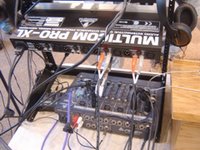 The audience participated in lecture by adding comments to the session based on their personal experiences and personal preferences. Participants in the advanced podcasting session were real experts in their fields. I noticed in the presences of internationally famous podcasters and professional musicians, network engineers from universities, recording and news entertainment media and corporations. One important consideration was that this conference tried real hard to (IMHO) to discourage commercial sponsorship. Those in attendance were more interested in sharing how podcasting works.
  I did not personally attend all the sessions, however topics discussed in those sessions included a variety of issues that included video blogging, copyright issues, and educational podcasting. After lunch, I did participate in Mr. David Warlick's session on podcasting in education.
Podcasting as a Teaching/Learning Strategy
Session Description
It was nice to finally meet Steven Dembo. I have been reading his blog at Teach42.com for some time and listening to his now famous car-podcasts recorded on his way to work as a technology director at in a private school. He has since moved on the a different challenge and I wish him the best. He is a visionary educator. I took some notes on my laptop during the session, however, due to some network issues the wireless network was mostly non-functional. I closed my laptop after becoming frustrated with not being able to blog the session in real-time and probably was able to focus more on what was being said. Steven Dembo was able to login to the wireless network using his laptop and documented some interesting and detailed information on his blog.

A great time!
When my head stops spinning from the facts and tech talk, I will try to sort out an idea or two on the possible instructional values of podcasting that I was thinking about while participating in today's event. L-R: John Blake, Dave Warlick, Steve Dembo, Jean Claude Bradely.
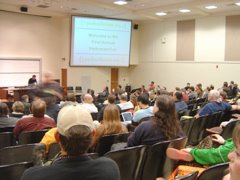
Mr. Blake attended a podcaster conference Saturday, Jan. 7, 2006, in Chapel Hill, NC. He participated in discussions on how schools use podcasting and listened to lectures on advanced podcasting topics. Attendees for this conference included a wide variety of interests and backgrounds. There were men and women from all over the nation participating in the sessions. Presenters in the sessions talked about how they used equipment to create their podcasts.
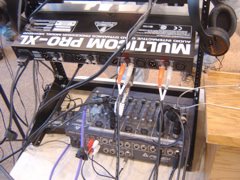 The audience participated in lecture by adding comments to the session based on their personal experiences and personal preferences. Participants in the advanced podcasting session were real experts in their fields. I noticed in the presences of internationally famous podcasters and professional musicians, network engineers from universities, recording and news entertainment media and corporations. One important consideration was that this conference tried real hard to (IMHO) to discourage commercial sponsorship. Those in attendance were more interested in sharing how podcasting works.
 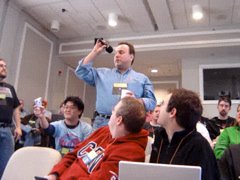 I did not personally attend all the sessions, however topics discussed in those sessions included a variety of issues that included video blogging, copyright issues, and educational podcasting. After lunch, I did participate in Mr. David Warlick's session on podcasting in education.
Podcasting as a Teaching/Learning Strategy
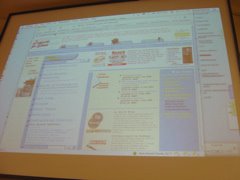
Session Description
New information and communication technologies are providing students with unprecedented access to the world they are learning about. Classroom walls are becoming invisible through the Internet and the information it causes to flow. What are the potentials of using podcasting to give voice to that world and to give voice to our students? What are the barriers, and what are the key entryways into leveraging global voices in our neighborhood schools? Join us in discussing the potentials and avenues of podcasting in the classroom <--click this link to read more....
It was nice to finally meet Steven Dembo. I have been reading his blog at Teach42.com for some time and listening to his now famous car-podcasts recorded on his way to work as a technology director at in a private school. He has since moved on the a different challenge and I wish him the best. He is a visionary educator. I took some notes on my laptop during the session, however, due to some network issues the wireless network was mostly non-functional. I closed my laptop after becoming frustrated with not being able to blog the session in real-time and probably was able to focus more on what was being said. Steven Dembo was able to login to the wireless network using his laptop and documented some interesting and detailed information on his blog.
Saturday, December 31, 2005
Mount St. Helens releasing lava at astonishing pace
Roughly every three seconds, the equivalent of a large dump truck load of lava -- 10 cubic yards -- oozes into the crater of Mount St. Helens, and with the molten rock comes a steady drumfire of small earthquakes
read more | digg story
read more | digg story
Predictions for Educational Technology in 2006
Anticipation of returning to school bright and early Monday morning, makes me a little nauseous. Maybe it is all the left-overs. Anyway-- while reading my blogines this morning, and drinking several cups of ginger bread flavored coffee, this useless information somehow made its way to my fingers: Predictions for Educational Technology in 2006.
Rob Hof’s article in the weeks BusinessWeek blog caused me to want to copy his writing idea. Thanks Rob. My writing style really lacks in many areas, but if you do not like it, go back to reading your aggregator, listen to PBS radio, or turn off your computer and go stand outside in the fresh air and run around the block.
It you are still read this, I hope you enjoy my stupid list of edtech predictions for the coming year-IMHO (in my humble opinion).
* Steven Dembo’s video wish list will grow to include a huge HDTV screen, Sony Vaio PC (and a Linux box with all the software, to make Miguel smile)
* Skype conference calls will make their way into the science classroom for students to create podcasts that are more “two-way” conversations about science topics and less “one-way” reading of scripts from their textbooks. Marc Pensky will be proud of this.
* Moodle’s new version will be rolled-out. The question is–will I be able to safely update to the new version without distroying months of testbank editing. I predict a major backing-up of our back-up.
* Blogging using MySpace.com and others will continue to be of interest between students, teachers, and administrators and the community.
* Video blogs on the Internet will not be as popular in classrooms due to bandwidth and concern of security for students, but will be used more as a way to communicate with homes. “this week I learned ____ in math and ____in social studies___and about_____ in science”. Including work samples or video clips of student work. Now, for the hard part, I predict homes will continue to not pay attention to what is happening at school until something “goes wrong.” Note: this is not true for all homes, but way too many– IMHO.
Rob Hof’s article in the weeks BusinessWeek blog caused me to want to copy his writing idea. Thanks Rob. My writing style really lacks in many areas, but if you do not like it, go back to reading your aggregator, listen to PBS radio, or turn off your computer and go stand outside in the fresh air and run around the block.
It you are still read this, I hope you enjoy my stupid list of edtech predictions for the coming year-IMHO (in my humble opinion).
* In the wake of publicity about mistakes and fabrications on various entries, the online volunteer-written encyclopedia Wikipedia will see growth skyrocket.
* Psychologists will identify a new disease, tagophilia: the obsessive compulsion to label everything on the Web using del.icio.us and other tagging sites. However, when Web 2.0 companies hear about it, they hire them all, quickly turning a neurosis into a promising new profession. My source: Rob Hof BusinessWeek
* Steven Dembo’s video wish list will grow to include a huge HDTV screen, Sony Vaio PC (and a Linux box with all the software, to make Miguel smile)
* Skype conference calls will make their way into the science classroom for students to create podcasts that are more “two-way” conversations about science topics and less “one-way” reading of scripts from their textbooks. Marc Pensky will be proud of this.
* Moodle’s new version will be rolled-out. The question is–will I be able to safely update to the new version without distroying months of testbank editing. I predict a major backing-up of our back-up.
* Blogging using MySpace.com and others will continue to be of interest between students, teachers, and administrators and the community.
* Video blogs on the Internet will not be as popular in classrooms due to bandwidth and concern of security for students, but will be used more as a way to communicate with homes. “this week I learned ____ in math and ____in social studies___and about_____ in science”. Including work samples or video clips of student work. Now, for the hard part, I predict homes will continue to not pay attention to what is happening at school until something “goes wrong.” Note: this is not true for all homes, but way too many– IMHO.
Friday, December 30, 2005
Top "7" Personal Tech Highlights for 2005
Shared the "podcast-kool-aid" with many educational professionals
Quoted in nationally syndicated magazine: student's using wikis in the classroom
Moodle site launched for online courses in our school district
Posted 8 Classroom Podcast Episodes, listed in iTunes and Yahoo directories: middle school and high school students featured as they reflect on their learning in science class.
Classroom Podcasts noted on Techpod
Technology Facilitator - North Whiteville Academy
Launched P2LS blog
Quoted in nationally syndicated magazine: student's using wikis in the classroom
Moodle site launched for online courses in our school district
Posted 8 Classroom Podcast Episodes, listed in iTunes and Yahoo directories: middle school and high school students featured as they reflect on their learning in science class.
Classroom Podcasts noted on Techpod
Technology Facilitator - North Whiteville Academy
Launched P2LS blog
Watch NOVA programs online for free !
This is a great science classroom resource. The Einstein piece on E=mc^2 isn't online yet, but for now you can watch "Elegant Universe", "Cracking the Code of Life", "Life's Greatest Miracle", "MARS - Dead or Alive?", among many others. . .
read more | digg story
read more | digg story
Tuesday, December 27, 2005
Savings With Open Source in Schools
This has been a point of discussion for some time. Let's assume that none of your school's families have computers and the students only use computers at school, then I can see using open source for teaching computer skills. As long as little Sally's grandmother has a PC with Works and her uncle has a PC with Word, Excel, and Powerpoint-- I see a problem. For example, I have a student that uses OpenOffice at home. When he downloads a template from our Moodle server to create his weekly current event, OpenOffice can open the file with not problem. However, he has never mastered to extra step to save his OpenOffice document to .doc file format. I know it should not bother me that his document does not display the same as the other students, but it actually makes my assessment process more difficult. When teachers use a Word document to assess student's work, we can post comments that can be read and responded to by the student. This comment feature reduces me from having to single out mistakes students make in their writing. From personal experience, and having received many writing assignments with so much red ink marked on them that I could not read them, I try to attach my comments with post-its. It is just one of those quarks of mine.
Using Open Source software Noxon School District saved $92,675.20. Linux and Open Source software allowed this school district to provide cutting edge technology to students.
read more | digg story
Update
I have been schooled on this topic today (Dec. 27th). Now I have a list of links to Linux distros that may work better than Novell's and a list of video editing apps for Linux. Several really good points have surfaced over on Miguel's blog: http://www.mguhlin.net/blog/archives/2005/12/entry_807.htm I have enjoyed replying to this topic. It has provided me with an enlightened view of open source. I still will continue to use our commercial software to edit video with our students and teachers. It works, it is paid for and the teachers know how to use it. Our students are learning how to use it too. As for a question of why we teach them to use video equipment, our state has a standard course of study: In accordance to Objective 3SC.05, "Select and use technology tools for class presentations". This is my justification. I will keep looking for open source software to use in my classroom.
I wonder this: how many people who advocate the use of Open Source in schools are actually using it as their primary OS? We've all got our excuses, but at the end of the day, who's actually walking the talk? I use Moodle and tikiwiki everyday with my students. But, my PowerBook running OS X is what I prefer. I have several apps that are open source running on it. Would I use Linux--absolutely. Should I use it- not without tech support. Would it help our school district- that is a good question and in my humble opinion is out of my realm of influence, yet is still food for thought.
Using Open Source software Noxon School District saved $92,675.20. Linux and Open Source software allowed this school district to provide cutting edge technology to students.
read more | digg story
Update
I have been schooled on this topic today (Dec. 27th). Now I have a list of links to Linux distros that may work better than Novell's and a list of video editing apps for Linux. Several really good points have surfaced over on Miguel's blog: http://www.mguhlin.net/blog/archives/2005/12/entry_807.htm I have enjoyed replying to this topic. It has provided me with an enlightened view of open source. I still will continue to use our commercial software to edit video with our students and teachers. It works, it is paid for and the teachers know how to use it. Our students are learning how to use it too. As for a question of why we teach them to use video equipment, our state has a standard course of study: In accordance to Objective 3SC.05, "Select and use technology tools for class presentations". This is my justification. I will keep looking for open source software to use in my classroom.
I wonder this: how many people who advocate the use of Open Source in schools are actually using it as their primary OS? We've all got our excuses, but at the end of the day, who's actually walking the talk? I use Moodle and tikiwiki everyday with my students. But, my PowerBook running OS X is what I prefer. I have several apps that are open source running on it. Would I use Linux--absolutely. Should I use it- not without tech support. Would it help our school district- that is a good question and in my humble opinion is out of my realm of influence, yet is still food for thought.
Subscribe to:
Posts (Atom)